Did you know you can breastfeed even if you didn't carry the baby?
Our Team
4/28/2025
Bonding beyond the womb by inducing breastfeeding for moms and their babies, even if moms did not themselves carry their pregnancy
Offering numerous physiologic and emotional benefits for babies as well as mothers, breastfeeding is widely acknowledged as the optimal feeding method for newly born infants. For over a decade the World Health Organization (WHO), the American Academy of Pediatrics (AAP), the American College of Obstetricians and Gynecologists (ACOG), and many other professional medical societies have globally endorsed exclusive breastfeeding for at least 4-6 months, with gradual introduction of complementary foods thereafter. Meanwhile, research continues to highlight health advantages of breastfeeding, including adaptive nutrition to the baby’s needs, improved cognitive development, enhanced immune function, stronger bonding, and emotional health regulation for both mother and child.
Interestingly, this also extends to mothers who did not experience pregnancy, such as women who become moms by using a gestational carrier, or by shared motherhood with their pregnant same-sex partners. Surprisingly often not known to non-carrying mothers, medical lactation induction can enable them to, still, breastfeed their babies, a point this article attempts to raise awareness about:
The general benefits of breastfeeding
For Babies:
Nutritional superiority - Breast milk is the gold standard in infant nutrition because it provides a balanced combination of proteins, fats, carbohydrates, and antibodies. It meets the baby's needs in a dynamic way no formula can replicate. For example, mothers of babies that demand to be fed more often and, therefore, usually in smaller quantities, will produce less caloric milk with more simple sugars and less fats, while mothers of babies that demand to be fed less often and in larger quantities will produce more caloric concentrated fatty milk.
Immunity Boost - Antibodies in breast milk, especially of IgA isotype, help protect the baby from infections, particularly during the early months after delivery, when the baby’s immune system is still developing with initial environmental exposures. Moreover, breast milk helps establish a healthy gut microbiota in the offspring, which plays a crucial role in the development of the immune system and of normal digestion.
Bonding and attachment: Breastfeeding fosters a unique bond between the mother and child. The physical closeness during nursing promotes attachment, emotional security, and a sense of trust, which are foundational for the baby’s emotional development.
Long-term reduced risks of chronic conditions: Long-term research indicates that breastfed babies are at a lower risk of developing obesity, diabetes, asthma, and certain childhood cancers. Some studies also show better cognitive development and higher IQ scores in breastfed children.
For Mothers:
Hormonal benefits - Breastfeeding releases the hormone oxytocin from the pituitary to aid in the so-called milk ejection reflex (i.e., lactation), but also has the function of helping the uterus to contract postpartum and preventing postpartum bleeding. This effect then over subsequent weeks allows the uterus to return to its pre-pregnancy size. Interestingly, oxytocin, also called the “love hormone,” in addition promotes the fetal-maternal bonding process, thereby enhancing the unique emotional connection between mother and offspring.
Enhanced emotional and mental health - Breastfeeding also fosters an added sense of closeness with the baby, which, in turn, has been reported to reduce the risk of maternal postpartum depression. Additionally, the act of breastfeeding promotes relaxation and emotional well-being through hormonal responses that reduce stress and foster emotional stability during the postpartum period and can create a sense of accomplishment and emotional satisfaction. Nourishing a child simply provides feelings of empowerment and fulfillment.
Long-term weight loss, metabolic health, and even reduced risks of certain cancers - Nursing burns calories, helping mothers more quickly to return to their pre-pregnancy weights. Breastfeeding has also been linked to a lower subsequent risk of obesity and type 2 diabetes in mothers and reduces a mother's risk of developing breast and ovarian cancers. The longer a woman breastfeeds, the greater the reduction in those risks.
Lactation Induction for Non-Pregnant Mothers
For those mothers who did not experience pregnancy but still wish to breastfeed, lactation induction is a very viable option. This option applies to mothers using gestational carriers and female partners of pregnant women who wish to share in the breastfeeding of their offspring.
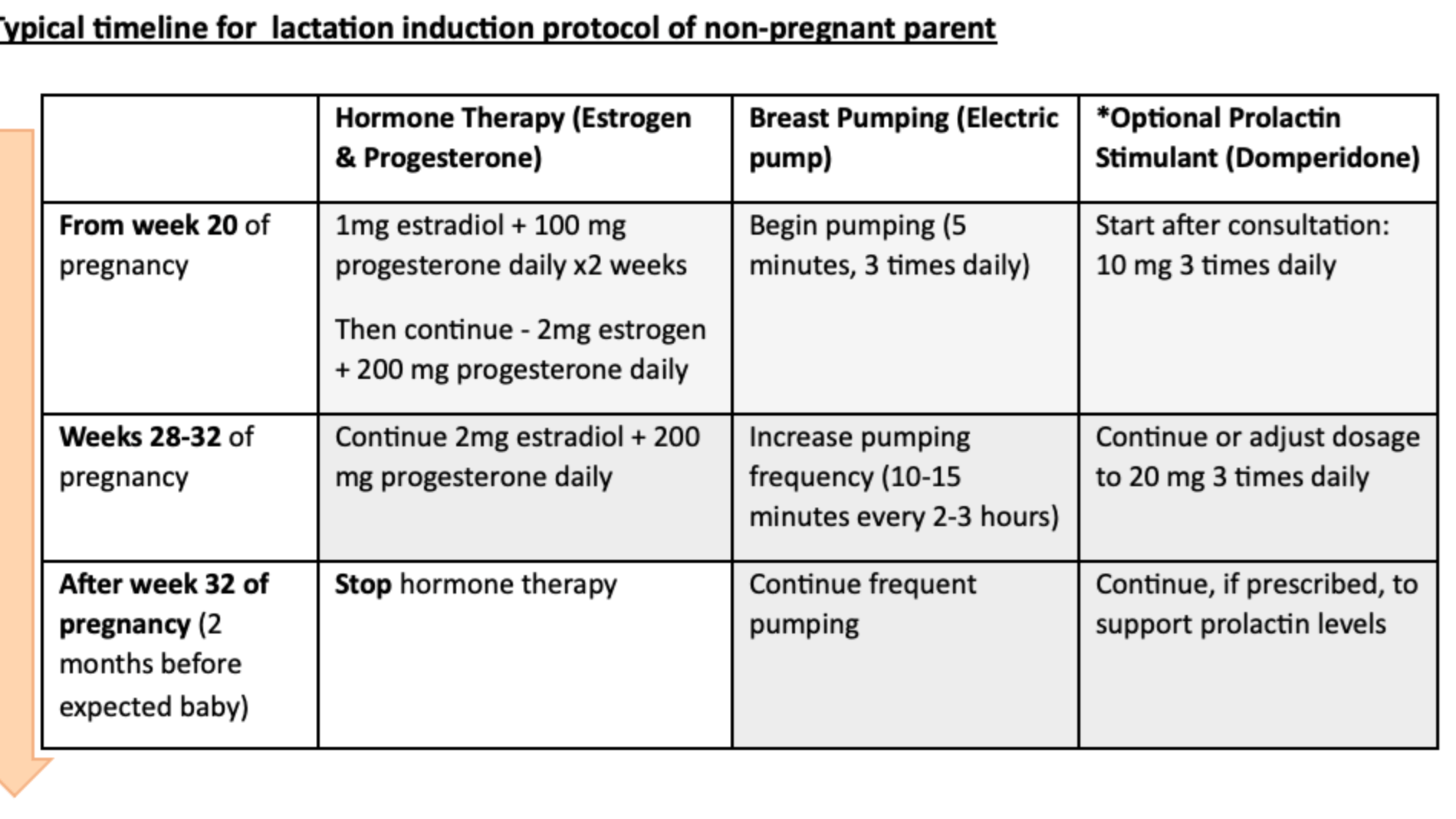
The process combines hormone therapy, intensive breast pumping, and at time even prolactin treatments to stimulate milk production in the non-pregnant woman. The goal is to mimic the hormonal environments of a pregnant woman in the third trimester of pregnancy and post-partum, which encourages the breasts to produce milk. And this treatment should be prescribed under the supervision of a healthcare provider. The table below offers the details.
&srotate=0)
After the baby’s delivery, start breastfeeding immediately and continue pumping. Also consider the possibility the amount of lactation may not be sufficient, in which case supplementation with formula or pasteurized donor milk may be needed. Here is more detail:
- Breastfeeding - Breastfeeding should be initiated immediately after birth even if maximal milk supply has not been established yet. Breastfeeding will further stimulate the breasts to produce milk.
- Continued Pumping – Pumping should even continue after feedings to further stimulate milk supply. The more often breasts are stimulated to produce milk - whether through direct breastfeeding or pumping, - the better the chances of establishing a good milk supply.
- Supplementation – Especially during initial weeks, there may be a need to supplement with formula or pasteurized donor milk until a more solid milk supply has been established.
By following a lactation induction protocol as here outlined and ensuring ongoing support and monitoring from a qualified healthcare providers, almost all non-pregnant women can successfully induce lactation and begin breastfeeding their babies immediately after birth. For women who did not themselves carry the pregnancy, the experience of breastfeeding their child may be even more important than for women who already established a “crosstalk” with their child during pregnancy. It is, however, a unique and rewarding experience for every woman and her child which plays an essential role in the unique relationship between mother and child, - truly a lifelong bond beyond the womb.
Reading List
Meek JY, Noble L; Section on Breastfeeding. Policy Statement: Breastfeeding and the Use of Human Milk. Pediatrics. 2022;150(1):e2022057988.
Prentice AM. Breastfeeding in the Modern World. Ann Nutr Metab. 2022;78 Suppl 2:29-38.
Del Ciampo LA, Del Ciampo IRL. Breastfeeding and the Benefits of Lactation for Women's Health. Rev Bras Ginecol Obstet. 2018;40(6):354-359.
Masi AC, Stewart CJ. Role of breastfeeding in disease prevention. Microb Biotechnol. 2024;17(7):e14520.
McGowan C, Bland R. The Benefits of Breastfeeding on Child Intelligence, Behavior, and Executive Function: A Review of Recent Evidence. Breastfeed Med. 2023;18(3):172-187.
Recent Posts
Stem Cells and Future Fertility Treatments
Stem cells and their potential role in fertility treatment are one of the most exciting areas of reproductive science research today.
AI in Embryo Selection
Artificial intelligence (AI) is quickly becoming part of modern medicine, including reproductive medicine.
Press Release: The CHR Announces a Clinical Trial
The CHR announces a clinical trial of the drug Finerenone in infertile women with POA and POI.